My Family Destroyed Grandpa’s Checks—Then the Bank Showed Me His Trust
My father was pounding on my apartment door when the bank manager called.
“Don’t let him in,” David Lyons said.
Through the wood, Greg Foster shouted my name again. He had never needed to shout to make me feel small. Usually one disappointed look did it.
“He says I stole from Grandpa,” I whispered.
David was quiet for a beat. “Ruby, I think your grandfather knew someone was stealing from him.”
The pounding stopped. My father’s voice came through the door, suddenly calm.
“Open up, sweetheart. We need to talk about those checks.”
Twenty hours earlier, my family had laughed at them.
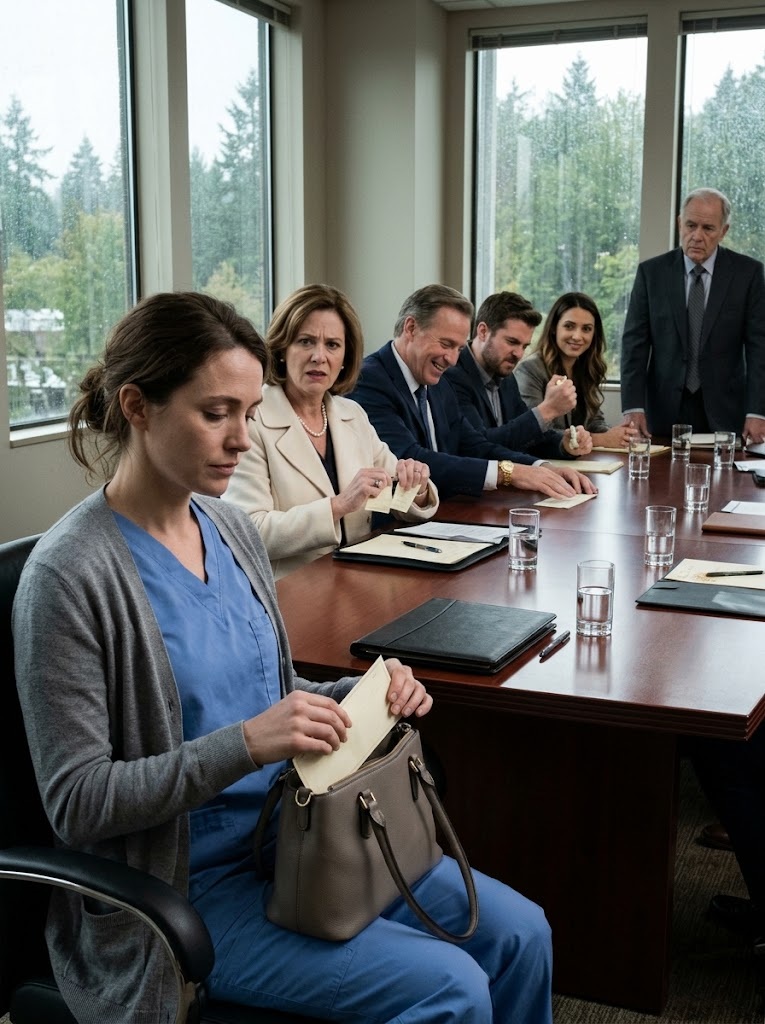
Mr. Caldwell’s conference room had smelled faintly of furniture polish and coffee. I arrived in my blue scrubs after a hospital shift, with rain still darkening the toes of my sneakers. My father was already seated near the head of the table, his gold watch displayed beside a closed folder. My mother, Brenda, wore her pearls. Derek sprawled in a chair, and Vanessa was fixing her hair in her phone’s camera.
I took the last seat.
For years, that had been my place in the family: close enough to be called when something needed doing, far enough away to be forgotten afterward.
Grandpa Silas had needed plenty done. Twice a week I drove to his Tacoma house with groceries, filled his pill organizer, changed his sheets, and listened while he talked about the ferries. My parents called him difficult. Derek called him cheap. Vanessa liked to film his cluttered kitchen and joke about how he lived “like a museum exhibit.”
His house had peeling porch paint. He clipped coupons. He saved rubber bands in a jar. None of us knew why an estate lawyer with an office like Caldwell’s was handling his will.
Caldwell read through the ordinary things first. The house. Personal belongings. Instructions for the funeral.
Then he gave each of us a cream envelope.
Mine held a check for five million dollars.
On the memo line, in Grandpa’s careful blue handwriting, were six words: For Ruby, who showed up.
I was still looking at those words when my father laughed.
“Dad couldn’t have paid the taxes on a sum like that.”
My mother held her check away from herself. “That can’t be real. Don’t fall for it.” She tore it down the middle and dropped the pieces on the table.
Derek crushed his in his fist. Vanessa lowered hers into her coffee and watched the ink run.
My father pushed his back to Caldwell. “Enough games.”
Then he saw me put mine in my purse.
“Ruby,” he said, “don’t be naive.”
I thanked Caldwell anyway. Grandpa had written on that check. Even if it was worthless, I wanted to keep it.
The next morning, I took it to Washington Fidelity Bank to ask whether the routing number was valid. David Lyons, the branch manager, unfolded it across his desk.
He entered the number. His expression changed so completely that I forgot to breathe.
He took me into a back office, locked the door, and asked what my family had done with their checks.
When I told him, he turned his monitor toward me.
The checks drew on a private trust Grandpa had established years earlier. The money was real. So were the instructions attached to it. Each check had to be presented intact within twenty-four hours of the will reading. A check that was destroyed, damaged, or expressly rejected would be canceled; its distribution would return to the master trust.
“My father gave his back,” I said.
David checked the record Caldwell had transmitted that morning. Greg’s rejection had been witnessed and logged. My mother’s torn check, Derek’s crushed one, and Vanessa’s coffee-soaked one had been photographed in the conference room. Caldwell had preserved them.
“And the master trust?” I asked.
David read the next line, then looked at me.
“You’re its successor beneficiary.”
I thought of Grandpa counting out coupons at his kitchen table.
“There must be a mistake.”
“There’s more than one condition,” David said. “Mr. Caldwell needs to explain the rest.”
I was still in that office when my father called the first time. By the time I got home, he was waiting outside my apartment. I slipped through the building’s side entrance and had barely closed my door before he started knocking.
Now, on the phone, David told me Caldwell was on his way to the bank with documents Grandpa had left for me. He advised me to stay inside and said he would wait while I called the police if my father tried to enter.
Greg knocked once more. “You think keeping that check makes you better than us?”
I kept the chain on and opened the door an inch.
He stood in the hall with his hands held out, the reasonable father ready to explain my mistake. My mother was behind him. Her pearls were gone.
“Caldwell called us,” Greg said. “He’s refusing to replace the checks. He says you’ve been named to take the money.”
“I only found out this morning.”
“Then you know it’s wrong.”
Brenda leaned around him. “Your grandfather was confused, Ruby. You know how he got.”
I remembered Grandpa balancing his checkbook with a magnifying glass when his eyes were tired. He had sometimes forgotten where he put his glasses. He had never forgotten what he paid for anything.
“Did you know about the trust?” I asked.
My father’s face tightened. “Open the door.”
I closed it instead. After they left, I waited until their car pulled away before going back to the bank.
Caldwell was in the private office with David. He had a hard-sided document case at his feet and the exhausted look of a man who had been expecting trouble.
He began with Grandpa’s money.
In 1998, Silas had sold patents for a navigation component he had developed with two former colleagues. Most of the payment went into a trust. He reinvested the proceeds and lived mainly on his pension. The trust had grown far beyond the five checks Caldwell had brought to the reading.
“He asked me not to mention the amount before the checks were distributed,” Caldwell said. “He wanted each of you to decide what to do with the instrument in your hands.”
“It was a test.”
“It was,” Caldwell said. “But not simply a test of manners.”
Three years earlier, someone had opened a line of credit against Grandpa’s house using a power of attorney that bore his signature. The debt was now just over four hundred thousand dollars. Some of the money had gone to a company my father owned. Other payments had covered Derek’s business expenses and a balance on one of Vanessa’s credit cards.
I shook my head. “Grandpa would have told me.”
“He tried to,” Caldwell said.
From his case he took a grocery receipt. On the back, Grandpa had written a date and four words in his small, cramped script: Greg took the blue folder.
I knew the folder. It had sat in Grandpa’s kitchen drawer beside the takeout menus. It held the deed to his house, insurance papers, and old bank statements. One Tuesday I had found the drawer open. Grandpa said he was looking for a phone number.