Dad Attacked Me Over Mom’s Sale Money—Then Her Hidden Recording Named Dana
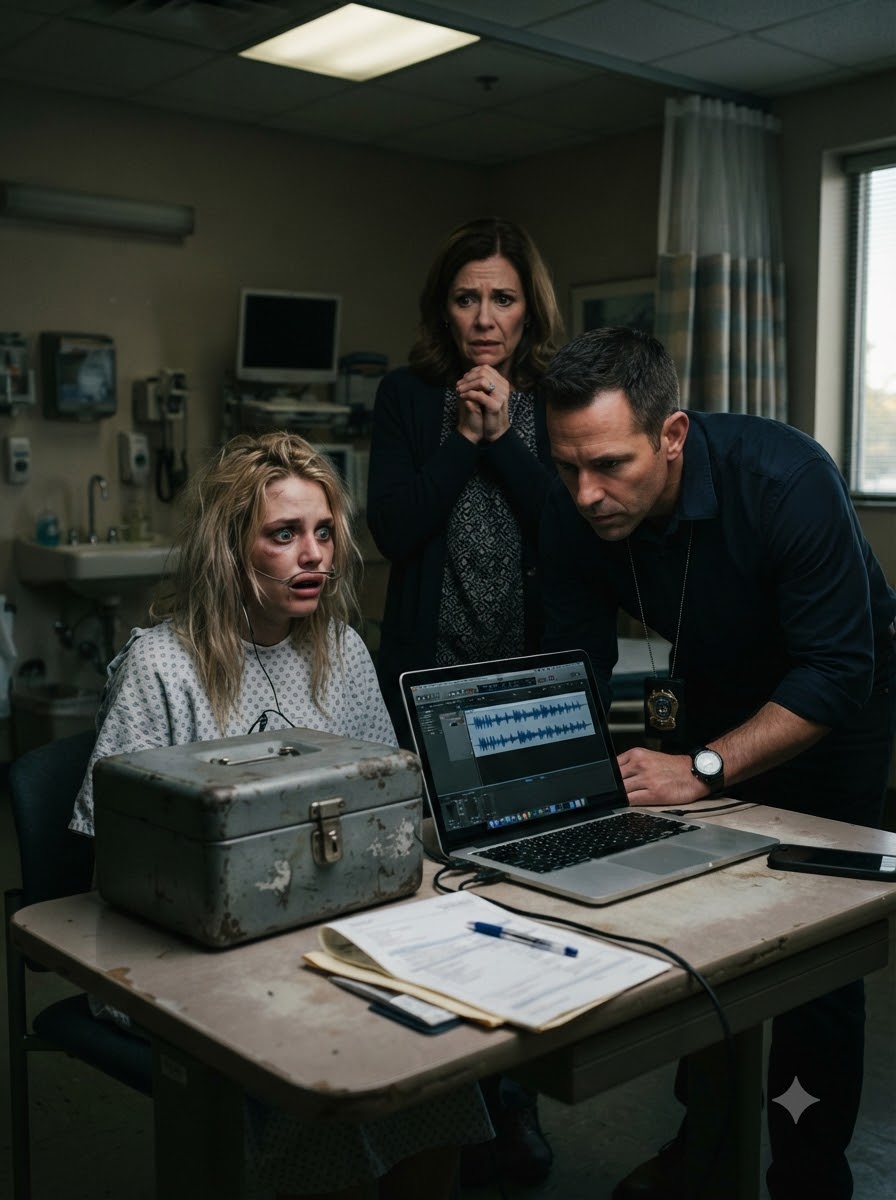
His hand closed around the wrench.
“Then you’ll learn,” Dad said, “what happens when you steal from this family.”
The wrench came toward my face.
I twisted, but not fast enough. Metal struck my jaw with a sound I felt more than heard. White light exploded behind my eyes. I dropped to one knee, still gripping the lockbox, and something warm filled my mouth.
When I spat, three teeth landed on the concrete.
For a moment, Dad stared at them.
Not at me. At the teeth.
Then he looked at the lockbox.
That was the detail I remembered most clearly later. Not the pain, not the blood, not the terrible crack traveling through my skull. His first concern was still the money.
I tried to crawl backward. My hands slipped in the blood running from my mouth. Dad raised the wrench again.
The phone in my back pocket was recording.
I had started recording ten minutes earlier, after his second demand for the cash. I had no plan beyond protecting myself from the argument I knew he would later rewrite. In our family, Dad never admitted to saying the thing everyone heard. He would say you misunderstood. He would say he was joking. He would say you made him angry and then act as if your anger had been the original crime.
My thumb had found the record button while I was folding the table.
Now the phone lay partly under my hip, still capturing his voice.
“Give me the box,” he said.
I tried to answer, but my jaw would not work.
He grabbed the front of my shirt and pulled me upright. The wrench hung beside his thigh. My vision swam. I could see the garage, the empty tables, the chair knocked sideways, and the little white teeth scattered across the driveway like bits of broken porcelain.
Then Dad shoved me down.
My head struck the concrete. The world narrowed to a ringing darkness.
I remember one more thing. The lockbox was still under my arm.
When I woke, I was in an ambulance with a paramedic holding my head steady and asking me what day it was.
I could not speak.
A police officer rode in the front. The paramedic leaned close and told me not to move my jaw. My tongue felt thick and useless. Every breath sent fire through my face.
At the hospital, doctors cut away my shirt and took photographs before washing me. There were bruises along my neck, a deep split under my chin, and a swelling that pushed one eye nearly closed. The first scan showed fractures in four places along my jaw. Two teeth were gone completely. Three more were loose. My cheekbone had a hairline fracture, and there was a small bleed near my temple that they monitored through the night.
They wired my jaw shut the next morning.
My sister Dana arrived three hours after surgery wearing sunglasses indoors. She stood at the foot of my bed and stared at the tubes, the swelling, and the metal holding my mouth closed.
“Oh my God,” she whispered.
I lifted my phone.
The police had taken it as evidence, but an officer had shown me a still frame from the recording. Dad’s face was visible. So was the wrench.
Dana sat down.
“Was he drunk?” she asked.
I shook my head.
“Did you say something to him?”
I stared at her until she looked away.
That was the first betrayal after the assault. Not Dad’s. His was expected. Dana’s was softer, dressed in concern, but it still landed where it hurt.
The detective assigned to the case was named Mara Bell. She was compact, gray-haired, and spoke with the patience of someone who had spent years listening to people explain why violence was not really violence.
She came to my hospital room two days later with a photographer and a sealed evidence bag. Inside was the wrench.
Dad had apparently dropped it near the garage after striking me. A neighbor, Mr. Patel, had seen him leave and called 911. Another neighbor, a teenager named Luis Moreno, had taken a photograph from his bedroom window before the ambulance arrived.
I had not known either of them was watching.
The photograph showed me on the driveway, one hand pressed to my face, the lockbox against my ribs. Dad stood over me with the wrench hanging from his right hand.
There was no ambiguity in the image.
Still, Detective Bell asked me to tell the whole story.
I wrote it on a yellow pad because I could not speak. The words came slowly. The argument. The money. The headstone. The blow.
At the bottom, I added one sentence.
He was not trying to scare me. He was trying to take the money.
Detective Bell read it twice.
“Did you know your father had money problems?” she asked.
I shook my head.
“Did you know the house had debt against it?”
Again, no.
She placed a folder on the bed tray.
“Your father told the responding officer that you attacked him first and that he raised the wrench defensively. He also said the garage sale money was supposed to pay a family tax obligation.”
My stomach turned.
“What tax obligation?” I wrote.
“That’s what we’re trying to determine.”
The lockbox had been found under my body. Inside was $1,847 in cash, along with the ledger I had kept. Detective Bell told me the money was entered into evidence, but she had already photographed every bill and receipt.
The evidence from the driveway was even stronger. My blood was on the wrench. Dad’s fingerprints were on its handle. My blood was also on the lockbox, which had a fresh dent on one corner. The laboratory found skin cells beneath my fingernails matching Dad’s DNA, consistent with trying to push him away.
The recording captured everything after my first refusal.
Open the box.
No.
That’s my money.
It belongs to Mom.
Your mother doesn’t own anything anymore.
Then the impact.
Afterward, the recording continued for nineteen seconds. Dad’s voice became distant as I lay unconscious.
“Ungrateful little thief,” he said.
There was a pause.
“Should’ve given me the money.”
Detective Bell played that section for me in the hospital.
I closed my eyes.
The prosecutor filed charges for aggravated battery, criminal domestic violence, and unlawful financial exploitation of a vulnerable estate. The last charge surprised me. I had thought the money was simply mine to use because I had earned it through the sale.
It turned out the house and its contents belonged to Mom’s estate. Dad was the surviving spouse, but that did not give him permission to empty the property, take sale proceeds, or interfere with a specific written request Mom had left behind.
That was the first layer of the truth.
Mom had made a will.
Not the simple document Dad had told everyone she never completed. A proper will, prepared by an attorney six months before her death. It left the house to me and Dana in equal shares, with a separate provision directing that the proceeds from any sale of personal belongings be used first for her memorial marker and cemetery expenses.