My Parents Believed Tom Said I Quit—Until I Entered Court With His Hidden Records
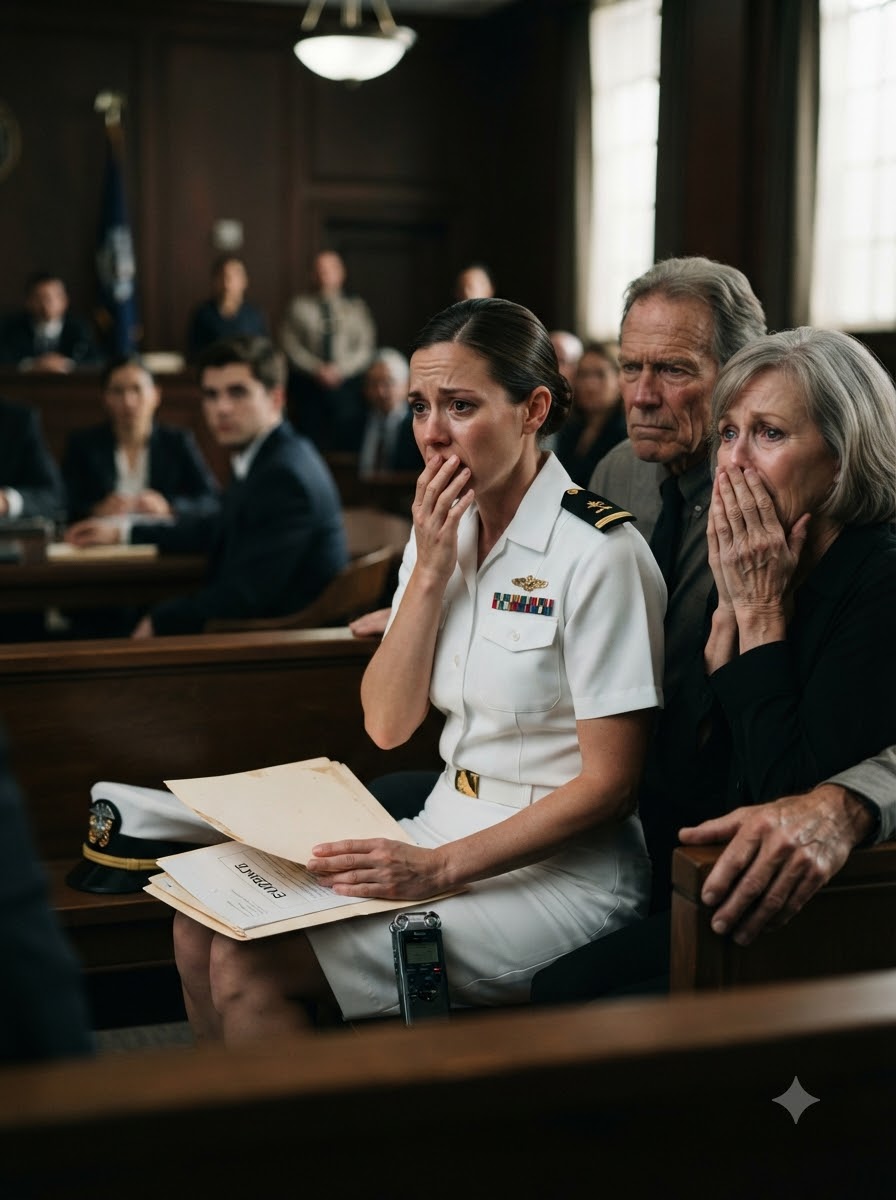
My mother’s hand flew to her mouth the moment I walked into the military courtroom.
My father gripped the bench in front of him so hard that the tendons stood out beneath his skin.
For a few seconds, neither of them seemed to understand what they were seeing.
Then my brother turned in the defendant’s chair.
Tom’s face lost all its color.
I stood beneath the courtroom lights in full dress whites, my ribbons aligned, my insignia bright against the fabric. Twelve years of service were pinned across my chest. Twelve years of early mornings, deployments, sleepless watches, emergency flights, and decisions made while other people were waiting for someone to take responsibility.
My parents stared at me as if I had returned from the dead.
But I had not disappeared.
They had simply decided I no longer existed.
The last time I had stood in front of them, I was eighteen years old and wearing a Navy training uniform. I had driven eight hours home to Hopewell, Virginia, because I believed they would be proud of me.
I had imagined my mother crying and hugging me.
I had imagined my father asking questions about boot camp.
Instead, my mother opened the front door only halfway.
My father stood behind her.
His expression was flat.
“You couldn’t finish it,” he said.
I thought he was joking.
“Finish what?”
“The Navy.”
My heart began to pound. “I did finish training. I’m home on leave.”
“Tom said they let you go.”
I looked past them, toward the living room where our old photographs still hung on the wall. There was one of Tom in his football uniform, one of my father holding a fish, and one of me at thirteen, smiling with a gap between my front teeth.
“Tom lied,” I said.
My mother’s face tightened. “He wouldn’t lie about something like that.”
That sentence did more damage than shouting could have.
I had spent weeks writing letters home from training. I had told them about the marching, the inspections, the exhaustion, and the small victories. I had written every Sunday because my father had always said that people proved themselves by showing up consistently.
Then Tom told them I had washed out.
They believed him after one conversation.
Not me.
Not the letters.
Not the uniform.
Not the fact that I had driven all the way home to tell them the truth.
My father stepped closer to the door. “You should have told us yourself if you were struggling.”
“I’m not struggling. I’m still in.”
My mother’s eyes filled, but she did not reach for me. “We need time.”
“For what?”
“To process this.”
“You’re processing a lie.”
My father’s jaw hardened. “Don’t come here and accuse your brother because you’re embarrassed.”
The door closed between us.
I remained on the porch for nearly ten minutes, staring at the brass wreath hook my father had installed when I was a child.
Then I walked back to my car.
I did not cry until I reached the interstate.
For twelve years, I carried the sound of that door closing.
I served anyway.
I completed training. I earned qualifications. I worked in logistics, first as a junior sailor and later as an officer responsible for supply chains that crossed oceans and supported entire units.
I learned how to read manifests, track inventory, identify false documentation, and notice the small details people overlooked when they wanted a report to look clean.
I deployed twice.
During my second deployment, a supply vessel was delayed by a storm, leaving an entire unit short on medical equipment. I spent thirty-six hours rebuilding the delivery schedule, coordinating with three commands, and finding an alternate route through a neighboring port.
When the shipment finally arrived, the commanding officer shook my hand.
“You kept people from going without,” he said.
That mattered more to me than any medal.
I never stopped sending letters to my parents.
At first, I wrote long ones.
I told them about promotions, new assignments, and the places I had seen. I told my mother about a stray cat that slept outside the barracks. I told my father that I had finally learned to repair a stubborn engine without calling for help.
They never answered.
The next year, I sent shorter letters.
Still nothing.
One Christmas, I mailed a card with no message inside. It came back several weeks later stamped RETURN TO SENDER.
I kept sending one every year anyway.
I told myself it was not begging. It was proof that I had not abandoned them.
Then I met Michael.
He was a Navy pilot with steady eyes and a patient way of listening. He never asked me to explain why I flinched whenever someone said, “Your family must be proud.”
He did not push.
He sat beside me through silence until I could fill it myself.
We married in a small chapel near the base. I mailed an invitation to my parents.
They did not come.
When our daughter, Emily, was born, I sent them a photograph of her wrapped in a yellow blanket.
At the bottom I wrote, You have a granddaughter.
There was no response.
By the time Emily was six, I had been promoted to lieutenant commander. At the ceremony, she sat in the front row swinging her feet beneath the chair. Afterward, she ran to me and gave me a stiff, serious salute.
“Good job, Mom.”
I laughed so hard I nearly cried.
That evening, after the guests left, I stood alone on the back porch and imagined my parents in the audience.
My mother would have taken too many pictures.
My father would have pretended not to be emotional.
They missed the ceremony because of a lie Tom had told when we were barely adults.
I thought that was the deepest wound my family would ever give me.
I was wrong.
Two years later, an internal disciplinary file landed on my desk.
It was part of a routine oversight review. The documents included shipping logs, inspection reports, inventory confirmations, and electronic authorization records.
I opened the first page without much thought.
Then I saw the name.
Thomas Mitchell.
I stopped breathing.
There were many Mitchells in the Navy. For several seconds, I tried to convince myself it was not him.
Then I read the identifying information.
Rank: Petty Officer First Class.
Station: Naval Supply Unit, Norfolk.
Investigation: falsified logistics documentation.
My hand tightened around the folder.
Tom had spent years telling our parents that I was a failure who could not survive military life.
Now he was under investigation for falsifying the records that military life depended on.
The allegations were not dramatic on the surface. No weapons had vanished. No secret documents had been sold. But military logistics was built on trust.
A shipment could be delayed because someone marked an inspection complete before it happened. A medical unit could be short on supplies because a petty officer claimed a delivery had arrived when it had not. A repair crew could be sent into danger because equipment was reported as serviceable when no one had actually checked it.
The file contained dozens of discrepancies.