My Son Cut Me From His Wedding—Then My Lawyer Exposed What He Forged
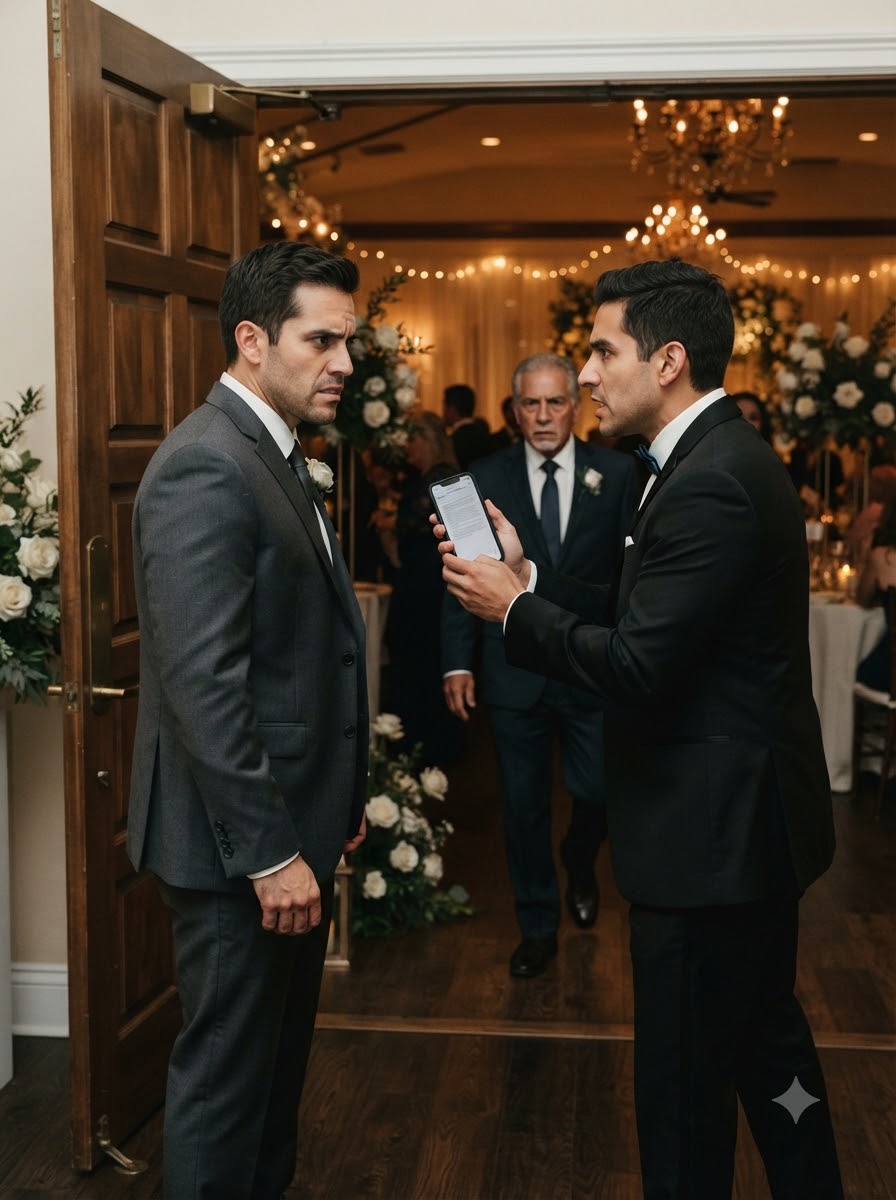
My son stopped me outside his wedding, looked at the white envelope in my hand, and whispered, “Dad… this is only for family. You’re not part of ours anymore.”
Behind him, through the tall glass doors, the ballroom shone like something from a magazine. Warm chandeliers glittered above round tables dressed in ivory linen. White roses climbed the walls. Waiters moved between laughing guests with trays of champagne.
Marta’s family had filled the room.
I stood in the garden wearing the dark gray suit I had bought for the occasion, my polished shoes reflecting the pale afternoon light. In my hand was a white envelope containing a wedding card, a check, and a letter I had written to my only son.
For a moment, I thought I had misunderstood him.
“Go where?” I asked.
Diego glanced toward the ballroom, as though he was afraid someone might see us. “Home.”
I studied his face. He was thirty-two years old, tall, clean-shaven, and dressed in a perfect black tuxedo. But all I could see was the five-year-old boy who had once slept with his fingers wrapped around mine because he was afraid of thunderstorms.
“You invited me,” I said.
“No, I didn’t.”
The words landed with a dull finality.
I looked down at the envelope. There had been no formal invitation, but I had assumed that was because I was his father. I had raised him. I had paid for the suit he was wearing. I had helped build the business that had paid for this ballroom.
Surely there had been some mistake.
Diego’s jaw tightened. “You weren’t supposed to come.”
“I’m your father.”
His eyes flickered away. “That doesn’t mean you belong here.”
Music drifted through the doors behind him. Someone laughed. A glass broke, followed by a burst of applause.
Then he leaned closer and lowered his voice.
“This wedding is only for family,” he said. “And you’re not part of ours anymore.”
I forgot how to breathe.
It was not the insult itself that broke something inside me. It was the practiced way he said it. He had rehearsed those words. He had been waiting for the right moment to use them.
I looked past him toward the ballroom. Marta was standing near the head table in a satin gown, surrounded by her mother, her sisters, and a cluster of relatives I barely knew. She glanced outside, saw me, and immediately turned her head.
That was when I understood.
This was not a sudden cruelty. It was an arranged removal.
I had simply arrived before they were ready to announce it.
“I’m sorry,” Diego said, though his voice held no apology. “Please don’t make a scene.”
I almost laughed.
A scene? I had spent twenty-seven years making sure his life never became one.
I had raised him alone from the time he was five. His mother had left us with two suitcases and a note on the kitchen table. Diego remembered almost nothing about her. I remembered everything.
I remembered working double shifts at the freight depot while he stayed with my sister. I remembered sitting beside him in emergency rooms, paying for stitches, fevers, broken fingers, and braces. When he was accepted into university, I sold a narrow strip of land my father had left me because the bank refused him a student loan.
When Diego graduated, he hugged me outside the auditorium and promised, “One day I’ll give you back everything.”
Years later, he came to my apartment carrying a folder of business plans. He wanted to start a logistics company but had been rejected by three banks.
I used my retirement savings, mortgaged my house, and invested nearly all of it.
He called the company Northstar Freight.
At first, the name made me proud. It was something we had built together. I never demanded a title or an office. I accepted a minority role because I wanted him to feel that the business was his.
But I had still provided the money.
The company’s original agreement gave Diego thirty-two percent ownership. I held sixty-eight.
That arrangement had never bothered either of us until Marta came into his life.
Marta was intelligent, elegant, and ambitious. When Diego first introduced us, she smiled warmly and called me “Mr. Alvarez.” Within a year, she had stopped using my name and started referring to me as “the investor.”
At first, I told myself she was simply formal.
Then the invitations began disappearing.
There were dinners I heard about afterward. Weekend trips that Diego claimed had been “too last minute” to mention. Business celebrations where he asked me not to attend because Marta’s family would be there.
He also became embarrassed by things he had once loved.
My old blue pickup was “an eyesore.” My house was “too modest” for guests. The Spanish food I cooked was “a little strong” for Marta’s parents.
Still, I kept showing up when he needed me.
When the company nearly lost a major contract, I negotiated with the carrier who had threatened to walk away. When Diego wanted a better office, I arranged a line of credit. When his accountant warned him about a tax penalty, I paid for Elena Ruiz, the best business attorney in the county, to review the company’s books.
I believed my son was under pressure.
I did not understand that he was being taught to see me as an obstacle.
The first undeniable warning came six months before the wedding.
I had gone to Northstar Freight to bring Diego two coffees. His assistant told me he was in the conference room. The door was not fully closed.
Marta’s voice carried into the hallway.
“My mother does not want him in the photographs,” she said.
I stopped.
Diego answered too quietly for me to hear.
Marta continued. “People will ask questions. Your father doesn’t fit with the family we’re presenting.”
“He’s my father,” Diego said.
“And he had his place in your old life. This is different.”
I stood outside that door with the coffees cooling in my hands.
Then Diego said, “I’ll handle it.”
I did not hear the rest.
I walked away before they saw me.
For weeks afterward, I said nothing. I watched instead.
I noticed that Marta’s family called Northstar “Diego’s company.” I noticed Diego did not correct them. I noticed that when someone mentioned my early investment, he said, “My father helped a little at the beginning.”
A little.
The phrase stayed with me.
Then Elena called.
“Ricardo,” she said, “did you authorize a transfer of nineteen percent of your interest in Northstar Freight to Diego?”
I was standing in my kitchen, holding a dish towel.
“No.”
“Did you sign anything electronically?”
“No.”
“Did you tell anyone you intended to transfer it?”
I hesitated.
“I told Diego I might give him nineteen percent as a wedding gift.”
“When?”
“Last year. We were discussing succession. I said I wanted him to become majority owner eventually.”
“Did you put that in writing?”
“No.”
Elena was silent for a moment.
“Then we have a problem.”
She sent me a copy of a document filed with the company’s records. It was labeled an ownership transfer agreement. According to the document, I had transferred nineteen percent of my shares to Diego three weeks earlier.