Margaret Took the Stroller—Until Ethan’s Attorney Opened the Folder
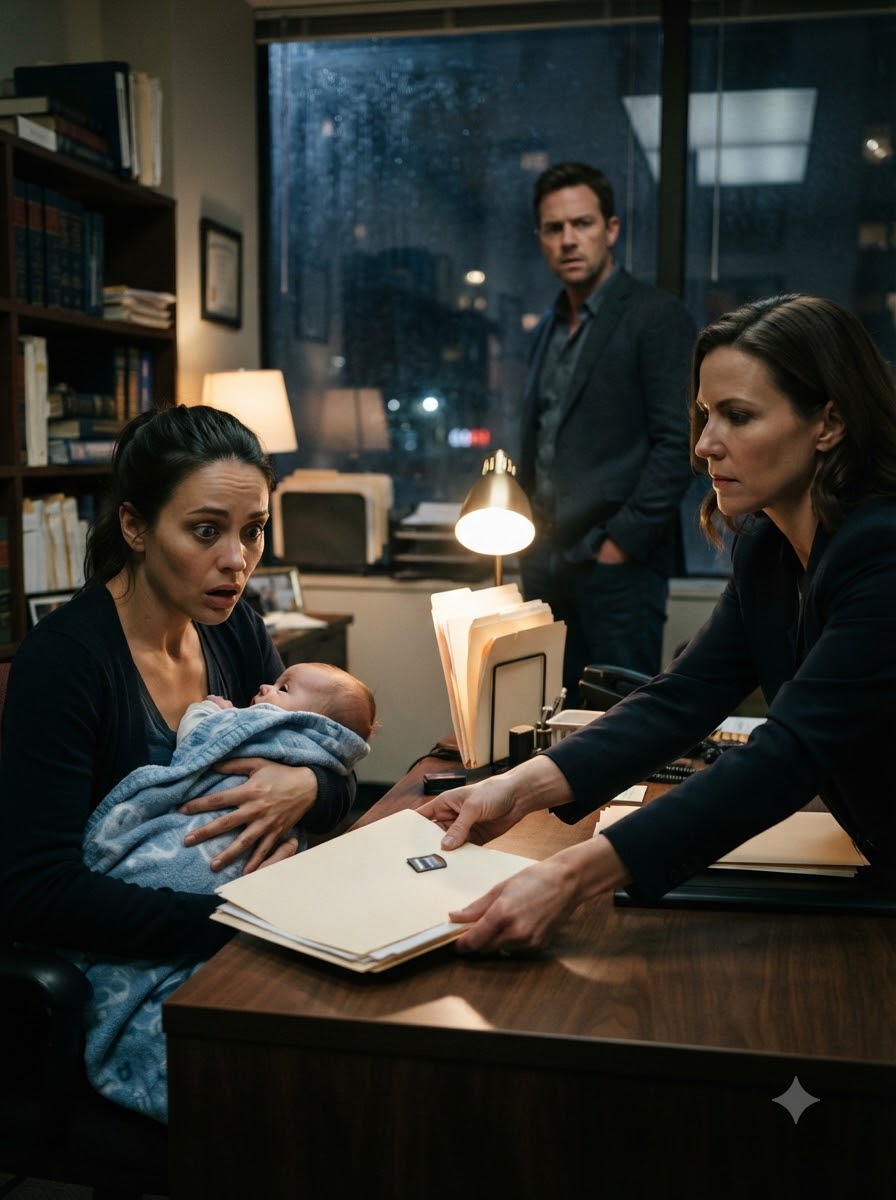
My husband had been dead for nine days when his mother pushed me into a storm with our three-month-old son in my arms.
Then she pulled the stroller back inside.
“That stays,” Margaret said.
Rain blew over the threshold and spotted the marble floor. She stood behind the stroller with both hands wrapped around its handle, as though she were guarding a priceless possession instead of refusing shelter to her own grandson.
“I paid for it,” she added.
Caleb shivered against my chest. His thin blanket was already damp. I tried to pull it higher around his head, but my fingers were shaking so badly that I could barely hold the fabric.
“Margaret,” I said, “please. He needs somewhere warm.”
She looked at the baby and then at me.
“You should have thought about what Caleb needed before you got my son killed.”
The words struck harder than the cold.
Behind her, her sister Diane stood near the dining room table, one hand pressed against her mouth. A neighbor who had come by with funeral flowers stared at the floor. No one defended me. No one even moved.
Margaret opened the door wider.
“Go.”
I looked past her toward the staircase, toward the room Ethan and I had shared, toward the kitchen where he had kissed Caleb’s forehead nine days earlier and asked whether we needed anything from the store.
“Diapers,” I whispered. “Milk. That’s all I asked him to get.”
“And he never came back.”
The storm had arrived earlier than predicted. Ethan’s car had hydroplaned on a flooded stretch of county road. He had been thirty-two years old. Our son had been three months old. I was twenty.
I had not yet learned how to grieve without checking the time for the next feeding.
Margaret had arrived at the hospital before I had fully understood that Ethan was gone. At first, she was silent. She held his hand, sobbed against his shoulder, and let me believe that grief had made us allies.
By the fourth day, she had begun watching me.
By the seventh, she was telling relatives that Ethan had been distracted because of me.
That morning, she cornered me in the kitchen while Caleb slept in his bassinet.
“You sent him out,” she said.
“For groceries.”
“Into a storm.”
“The storm wasn’t supposed to reach us for another hour.”
“My son would be alive if he had never met you.”
I had learned quickly that anything I said became another accusation. If I cried, I was manipulating her. If I stayed quiet, I was admitting guilt.
So I said nothing.
Margaret went upstairs and returned with the small suitcase I had brought when Ethan and I moved into her house. She dropped it beside the front door.
“Pack what’s yours.”
I stared at her. “You’re throwing me out?”
“I’m removing the woman who destroyed my family.”
“And Caleb?”
“He’s my grandson.”
“Then let us stay.”
Her face hardened.
“You don’t get to use him as a shield.”
I packed with one hand while holding Caleb with the other. Two sleepers. A package of diapers. Three bottles. The little blue blanket Ethan had chosen before our son was born.
When I reached for the diaper bag, Margaret snatched it away.
“I bought that.”
“Please.”
She took the stroller next.
“I bought this too.”
My hands began to tremble.
“Margaret, it’s raining. He’s three months old.”
She leaned close enough for me to smell the coffee on her breath.
“So was my son once.”
Then she opened the door.
The wind rushed in.
Caleb began to whimper.
I tucked the blanket around him, stepped onto the porch, and turned once more.
Margaret was already pulling the stroller backward.
The lock clicked behind me.
For nearly two hours, I walked.
The first shelter I called had no beds. The second did not accept infants overnight. A church office sent me to voicemail. My phone battery fell from twelve percent to eight, then six.
Caleb’s body grew colder against mine. I kept moving because I was afraid that if I stopped, I would collapse.
At last I found an awning outside a closed hardware store. I crouched beneath it, holding Caleb beneath my coat.
Thunder rattled the glass.
“I’m trying,” I whispered into his damp hair. “Daddy would know what to do. I’m trying.”
Headlights emerged through the rain.
A black sedan slowed at the curb. The passenger window lowered.
“Lena?”
Grant Douglas was out of the car before I could stand.
He had been Ethan’s closest friend since high school. He was broad-shouldered, usually calm, and one of the only people Margaret had never managed to frighten.
He opened an umbrella.
Then he saw Caleb.
“Where’s his coat?”
I couldn’t answer.
“Where’s the stroller?”
“She kept it.”
His expression changed.
“Margaret?”
I nodded.
He swore once, quietly, and opened the back door.
“Get in.”
He wrapped his jacket around Caleb while I climbed into the warm car. The heat hurt my skin. It was the first time since leaving the house that I had felt anything except cold.
Grant called an urgent-care clinic while driving. A doctor examined Caleb forty minutes later and told me he was chilled, exhausted, and hungry, but not dangerously ill.
I cried so hard in the examination room that the nurse had to bring me water.
Grant waited in the hall.
When we left, he did not drive toward a shelter.
“Where are we going?” I asked.
“To a lawyer.”
“I can’t pay a lawyer.”
“Ethan already did.”
I looked at him.
Grant kept his eyes on the road. “He knew Margaret might try to leave you with nothing.”
My heart began pounding.
“What does that mean?”
“It means he had me promise not to tell you until the paperwork was finalized.”
“What paperwork?”
He reached toward the locked glove compartment, then withdrew his hand.
“First you see Rebecca Shaw. Then you’ll understand.”
Rebecca Shaw’s office occupied the second floor of an old brick building downtown. It was almost midnight, but every light inside was on.
The attorney stood when we entered. She was in her fifties, dressed in a charcoal suit, with silver hair cut neatly at her jaw.
“Lena Ward?” she asked.
I nodded.
She looked at Caleb, then at the wet blanket around him.
Her expression tightened, but she did not ask questions. She only guided us into a conference room.
On the table lay a thick sealed folder.
My name was written across it in Ethan’s handwriting.
I knew the slanted E immediately.
My knees weakened.
Rebecca opened the folder and placed the first document before me.
At the top was a property description.
I recognized it as Margaret’s house.
Beside the word OWNER was my name.
I stared at it.
“I don’t understand.”
“Ethan purchased the property from his mother three months before Caleb was born,” Rebecca said. “The deed was recorded six weeks ago.”
I looked at Grant.
He was silent.
“Why would he do that?”
“Because he believed Margaret was preparing to evict you after his death,” Rebecca said. “He also believed she intended to challenge your marriage and control the house.”
My mouth went dry.