My Daughter-in-Law Changed My Door Code—Then Police Found Her Cancer Treatment Plan
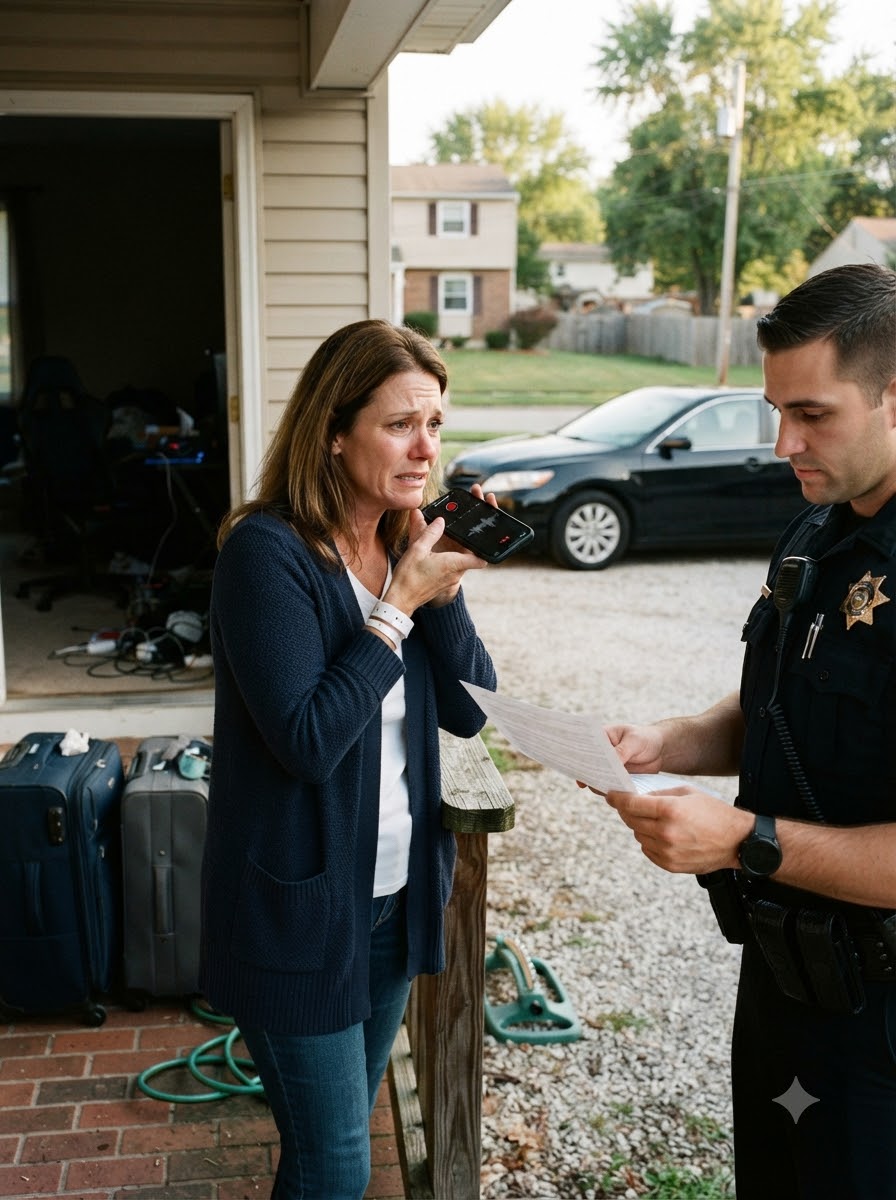
The first suitcase was open on the lawn when I came home from chemotherapy.
My underwear lay in the wet grass beside the sprinkler. One of my blouses had caught on a rosebush, its sleeve fluttering like a white flag.
The second suitcase stood upright near the curb, rain-spotted and bulging. A black garbage bag had been knotted around the handle. Someone had written CAROL’S MEDICAL THINGS across it in thick red marker.
I sat behind the wheel for several seconds, too stunned to move.
My left hand still wore the plastic hospital wristband. A square of gauze covered the place where the oncology nurse had removed my IV. I was nauseated, lightheaded, and so tired that even turning off the engine felt like work.
Then I looked at my house.
Through the front window, I saw Kendra’s brother, Brett, rolling a blue gaming chair across my living room.
He disappeared down the hallway toward my downstairs bedroom.
My bedroom.
I got out of the car and crossed the driveway slowly, holding the handrail as I climbed the porch steps. I entered the code I had used for six years.
The keypad flashed red.
I tried again.
Red.
The deadbolt did not move.
Kendra opened the inner door but left the storm door locked between us. She was wearing leggings and one of my late husband’s Ohio State sweatshirts.
“You shouldn’t be here,” she said.
For a moment, I honestly thought the medication had made me misunderstand her.
“This is my house.”
“Nathan said he would explain.”
Behind her, Brett appeared carrying a monitor. He saw me and looked away.
“Why are my clothes on the lawn?”
Kendra folded her arms.
“We packed what you’ll need. The rest can be sent once you have a permanent address.”
“I have a permanent address.”
My voice shook, but not from fear. The cold fury had not reached my limbs yet. It was still gathering somewhere under my ribs.
“This one.”
I called Nathan from the driveway.
He answered on the sixth ring with a sigh, as if I had interrupted something important.
“Mom.”
“What have you done?”
There was a pause. I heard traffic around him.
“Kendra’s brother lost his apartment,” he said. “He needs somewhere stable.”
“So you put him in my bedroom?”
“The downstairs room makes sense for him. He has equipment.”
“Equipment?”
“His streaming setup.”
I looked at the hospital wristband on my arm.
“Nathan, I have cancer.”
“I know that.”
“I had a four-hour infusion today.”
“And honestly, your chemo appointments are stressing Kendra out. Everything in the house has become about your illness.”
For five years, Nathan and Kendra had lived under my roof.
They had arrived with a U-Haul and a promise that it would be for twelve months. They wanted to save for a down payment. I charged no rent. I paid the property taxes, insurance, water, electricity, and most of the groceries.
Twelve months became five years.
They remodeled my upstairs guest room without asking, filled my garage with Kendra’s online resale inventory, and gradually began speaking of the house as theirs.
Still, I never believed my son would lock me out of it.
Kendra stepped onto the porch holding a laminated sheet of paper.
“Nathan signed a lease agreement with my brother,” she said. “Brett has legal possession of the downstairs suite.”
She held the paper against the glass so I could see a row of signatures.
One was Nathan’s.
One was Brett’s.
The third looked like mine.
“If you don’t leave the driveway,” Kendra continued, “I’m calling the sheriff for trespassing.”
I looked past her toward the cul-de-sac.
Two sheriff’s cruisers were turning the corner.
Kendra smiled.
Then she noticed their lights were not flashing, and her smile faltered.
“You called them?” she asked.
“Twenty minutes ago.”
I reached into my purse and removed the folder I had collected from my bank on the way home.
Inside were a certified copy of my deed, three fraud alerts, and a printout showing that someone had tried to borrow $186,000 against my house.
The first deputy was a gray-haired woman named Alvarez. Her partner, Deputy Cole, was younger and carried a small body camera centered on his vest.
I gave them my driver’s license and deed.
“This property belongs to me,” I said. “My son and daughter-in-law are guests. They changed the locks while I was at an oncology appointment.”
Kendra hurried down the steps, still clutching her laminated paper.
“That’s not accurate,” she said. “Carol has been transitioning into assisted living. This was planned.”
Deputy Alvarez looked at me.
“Are you transitioning into assisted living?”
“No.”
“She’s confused,” Kendra said quickly. “The treatments affect her.”
“I’m not confused.”
Kendra shoved the document toward the deputy.
“We have a lease. Carol signed it.”
Alvarez studied the page.
The supposed lease began that morning and granted Brett exclusive use of the entire first floor for three years at one dollar per month. My forged signature appeared above a line stating that I had permanently surrendered access to the property.
Alvarez looked up.
“Where was this notarized?”
Kendra pointed to a seal near the bottom.
“At a shipping store.”
“Which one?”
“I don’t remember.”
“Who is Denise Marlow?”
“The notary.”
Alvarez turned the sheet over.
There was no certificate language, no commission expiration, and no identification details.
Only a gold sticker pressed into the paper.
“That isn’t an Ohio notarial seal,” she said.
Kendra’s face changed.
“It’s what Nathan gave me.”
The blame had already begun moving.
Deputy Cole asked Brett to come outside.
He emerged from my hallway with a screwdriver tucked into his back pocket.
“Did you change the lock?” Cole asked.
“Kendra hired a guy.”
“Did you know the owner had not agreed to move out?”
Brett looked at his sister.
“She said the old lady was going to a facility.”
I was sixty-three.
Alvarez told Kendra to open the door. Kendra refused.
“This is a civil issue.”
“Locking an owner out of an occupied home can become a criminal issue,” Alvarez replied. “Open it.”
When Kendra still did not move, Brett reached around her and unlocked the storm door himself.
The smell hit me before I stepped inside.
My eucalyptus hand cream. Kendra used it when she went through my drawers.
My framed wedding photograph was gone from the mantel. In its place sat Brett’s game console.
The dining table was covered with papers, packing tape, and empty coffee cups. My laptop lay open near the center.
I had left it locked in my bedroom.
Deputy Cole photographed everything.
We walked down the hall.
My bedroom looked as though it had been searched during a burglary. Drawers had been emptied onto the floor. My husband’s old lockbox stood open on the bed.
The spare house key was missing.
So were my passport, Social Security card, birth certificate, tax returns, and the folder containing my mortgage satisfaction documents.
Brett’s computer tower had already been placed beside my dresser.
My wigs were stuffed into a garbage bag near the bathroom.
For the first time that afternoon, my knees failed me.
I sat on the edge of the mattress.
Kendra leaned against the doorframe.