The Shared Calendar Said “South Gate.” I Thought My Wife Was Scheduling Sex—Until She Told Me What the Code Was Protecting
The number was six, but six was already the wrong shape for what had happened.
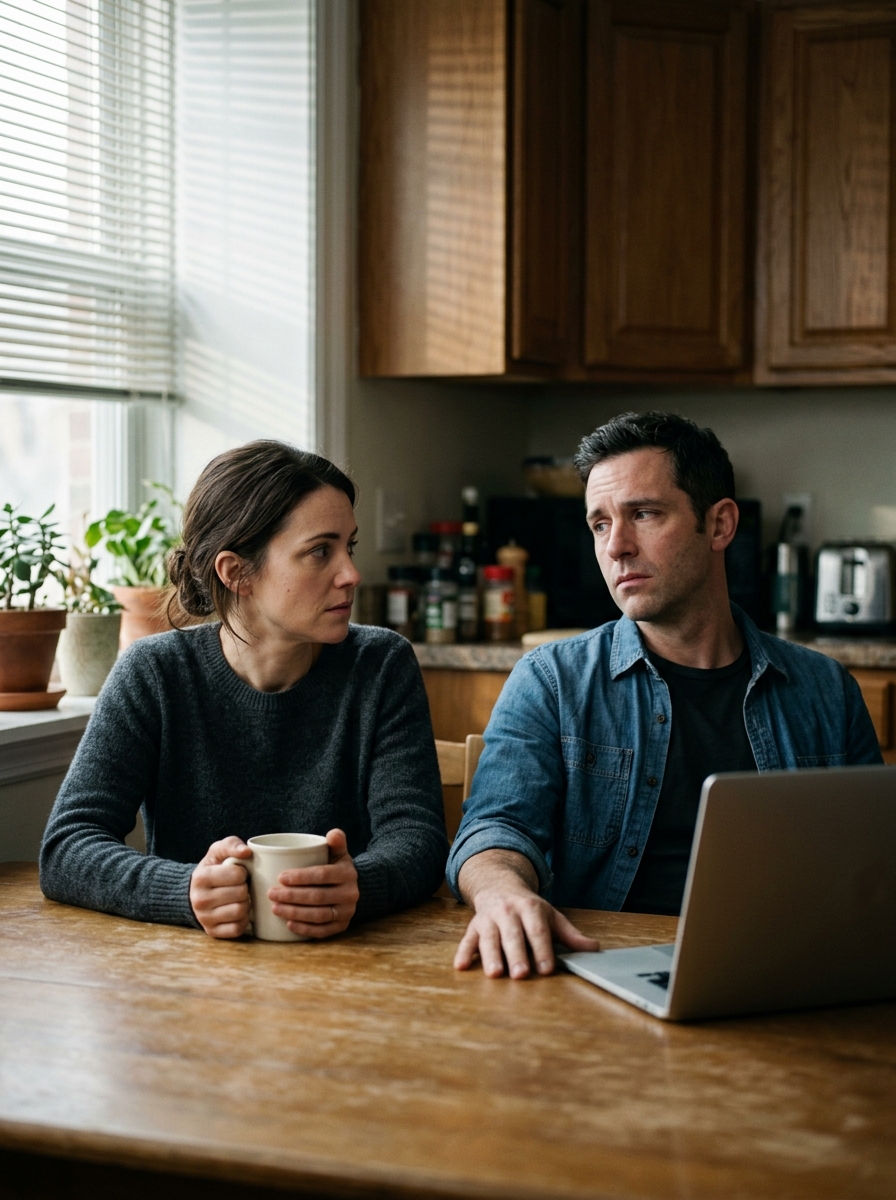
Mara sat across from me at our kitchen table, both hands wrapped around a mug she had stopped drinking from. She was thirty-eight, with her dark hair twisted into the loose knot she wore when she was tired, and a faint pencil mark along the side of her hand from work. I had loved that mark before. That morning, I couldn’t stop looking at it.
“Six times you didn’t want to be with me?” I asked.
“That’s not what I said.”
“It’s what I heard.”
“You heard a verdict.” She rubbed her thumb along the mug’s handle. “I’m telling you about a process.”
I hated the word. It was the kind of word that belonged in one of Mara’s project meetings, where people discussed delivery dates and revised scopes. Not between two people who had been married for nine years.
The shared calendar remained open on my laptop. Three green blocks sat in the weeks ahead, all labeled SOUTH GATE. The first was that night.
I had clicked the entry before breakfast because I thought it was work. Mara managed renovations for an old downtown arts center, and “South Gate” sounded like exactly the kind of problem she dealt with: access badges, contractor schedules, a door that refused to close.
Instead, the note beneath the title said, “No work. Phones away. Stop by 10:30.”
I had clicked the second entry.
“Don’t promise an outcome.”
The third said, “Ask before assuming.”
Those words had been written by my wife about time with me.
“You made a set of instructions,” I said.
“I made reminders.”
“For what?”
“For how not to turn an evening into an examination.”
I stood up, then sat back down. The kitchen suddenly seemed too small for both of us. Our house had always been modest—two bedrooms, a narrow staircase, a living room with one stubborn radiator—but that morning every wall felt close enough to hear.
“Were you attracted to me?” I asked.
Mara looked at me. “That is not a fair question.”
“Why?”
“Because you’re asking me to turn something complicated into a sentence that will either soothe you or destroy you.”
“I deserve to know if my wife wanted me.”
“You deserve honesty. That isn’t the same as getting an answer you can use as a receipt.”
I flinched.
She saw it. “I’m not trying to be cruel.”
“I know.”
“I did want you. I do want you. But wanting someone isn’t a switch that turns on because a calendar block says it’s time.”
“I never thought it was a switch.”
“You thought it was a vote.”
I looked away.
Mara let out a breath. “If I wanted you, we were okay. If I didn’t, something was wrong. That’s what it felt like you believed.”
“I wanted to feel wanted.”
“I know.”
“And you made me feel like wanting you was embarrassing.”
Her mouth parted, then closed.
I regretted the sentence as soon as it left me, but not enough to take it back.
She stood, carried her mug to the sink, and rinsed it even though there was nothing left in it.
“I never wanted to make you feel embarrassing,” she said. “But I did need you to understand that my body couldn’t keep being the place where we settled every question about our marriage.”
***
The first South Gate entry had appeared four months earlier.
Mara had been caring for her mother, who had fallen in the bathroom of her apartment and broken her wrist. The injury wasn’t life-threatening, but the aftermath had swallowed our weeks: insurance calls, medication lists, rides to physical therapy, arguments with her brother over who was doing enough.
I helped where I could. I drove. I assembled a temporary rail beside the toilet. I sat in the waiting room while Mara met with the occupational therapist.
But support did not make me immune to loneliness.
One Wednesday night, Mara came home after spending three hours at her mother’s place. She dropped her purse by the door and stood in the hallway without taking off her coat.
I was making pasta. The kitchen smelled of garlic and scorched butter.
“You okay?” I asked.
“No.”
“Do you want to talk?”
“Not really.”
I turned down the burner. “Do you want to go to bed?”
She looked at me then. “I want to sleep.”
The distinction should have been simple. It wasn’t.
“Okay,” I said.
I tried to make the word neutral. I thought I succeeded.
After dinner, Mara went upstairs. I stayed in the kitchen and washed dishes harder than necessary. She came back down twenty minutes later.
“Are you angry?”
“No.”
“You’re washing the same plate.”
I looked at the plate in my hand. “I’m not angry.”
“You’re upset.”
“I’m allowed to be upset.”
“I didn’t say you weren’t.”
“You don’t have to.”
She folded her arms. “What does that mean?”
“It means I can have feelings without turning them into your responsibility.”
“You say that, but then you walk around the house like someone died.”
I set the plate in the drying rack. “What would you like me to do?”
“I’d like you to still be my husband.”
The sentence stayed with me because I didn’t know how to answer it.
I thought I was protecting her from my disappointment. If I kept my distance, if I did not ask for reassurance, if I didn’t touch her when she had already said no, then I was being respectful.
Mara experienced it as a punishment.
Not an intentional one. That was part of what made it difficult. I didn’t slam doors. I didn’t accuse her of not loving me. I became quieter. More efficient. I took care of the house and stopped reaching for her.
I turned a no into an atmosphere.
The next day, I apologized. She accepted, but something in her remained braced.
Two weeks later, after another late night at her mother’s, she found me sitting at the edge of our bed.
“Do you want to be close?” I asked.
She looked exhausted. “I don’t know.”
I nodded. “Okay.”
That was all I said, but my face must have changed. I could feel the old hurt rise in me, quick and childish. Mara reached for my hand.
“Jonah.”
“I’m fine.”
“You’re not.”
“I said I’m fine.”
She pulled back.
That night, I slept badly. The next morning, I apologized again. She told me she didn’t want an apology every time she declined sex.
“I want you to believe me,” she said.
“I do believe you.”
“You believe the words. You don’t believe the relationship survives them.”
I had no answer.
***
Mara told me she created the first South Gate block after that.
She had been sitting in her office, looking at a week filled with staff meetings, contractor calls, her mother’s appointments, and an overdue grant report. She realized that if she waited for an unplanned moment when she felt relaxed, available, and spontaneously desirous, we might go months without touching.
That frightened her.
Not because she thought sex was an obligation. Because she missed the part of herself that could move toward me without first passing through a list of everything else that needed doing.