The Book Promised 30 Days Back to Desire. By Day Seven, He Was Risking His Health to Pass.
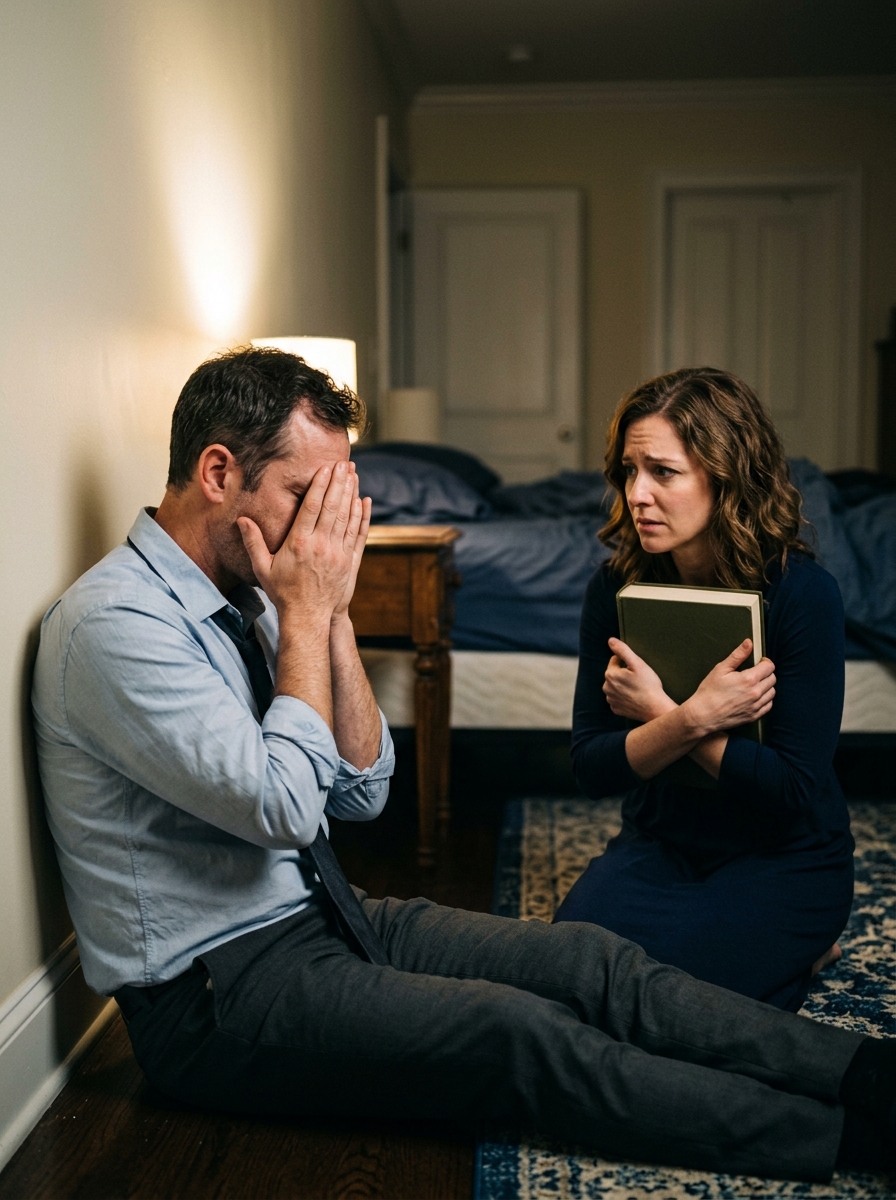
On the seventh night of the intimacy challenge, Mina Mercer waited in the bedroom while her husband stood frozen in the doorway.
Grant was still wearing his work clothes. His tie hung loose, and one hand gripped the doorframe as though the room had tilted.
Mina had spent an hour changing the bedroom into something softer than the place where they slept back-to-back and discussed grocery lists. She had turned off the overhead light, moved two lamps onto the dresser, and queued the playlist from their first apartment. She wore the navy dress Grant had once said made her look fearless.
The book lay open on the bed.
DAY SEVEN: CHANGE THE SCRIPT.
One partner was supposed to plan. The other was supposed to receive without retreating into routine.
The paragraph beneath it emphasized mutual willingness. They had even made their own rule before starting the challenge: either person could stop any prompt, at any time, without penalty.
Still, the room looked like expectation made visible.
“Hey,” Mina said. “You can say no.”
Grant’s mouth opened, but nothing came out.
She reached for the bedside lamp. “We don’t have to do this one.”
“I need a minute.”
“Okay.”
He took one step into the room, then sat hard on the floor. He covered his face with both hands. His shoulders began to shake.
Mina’s first impulse was to touch him. She stopped herself.
“Grant?”
“I can’t do tonight.”
“That’s okay.”
“No, you don’t understand.” His words came through his hands. “I can’t keep proving I want you by making myself sick.”
The music kept playing behind them, an old song with a bright guitar riff that suddenly sounded obscene.
Mina crossed the room and shut it off.
Grant lowered his hands. His face was pale, his eyes too bright. At thirty-nine, he looked younger when frightened, though Mina knew he hated that she could see it.
“What did you do?” she asked.
“I stopped taking my medication.”
She crouched several feet away from him. “Which medication?”
He gave her a look that answered.
Eight months earlier, Grant’s first major panic attack had sent him to the emergency room convinced his heart was failing. It had begun on an ordinary Tuesday while he was presenting a transit proposal to twelve people who already supported it. By the time an ambulance arrived, he could barely tell the paramedics his name.
Treatment had helped. The medication quieted the constant electrical hum under his skin. He slept again. He drove on the freeway. He could sit through meetings without counting exits.
It had also changed his desire.
He still kissed Mina goodbye. He still reached for her hand in parking lots. But sexual interest had become quieter and less predictable, and his body no longer responded on command.
Mina had tried not to turn that into a verdict on herself.
Then she had bought the book.
“When did you stop?” she asked.
Grant looked at the carpet. “Last Sunday.”
“The first day.”
“Yes.”
“For the entire challenge?”
“Yes.”
Mina stood too quickly. The room swayed, though she was not the one having symptoms.
For six nights, she had thought they were finding each other again. They had sat knee-to-knee and named favorite memories. He had sent her a flirtatious message during work. They had kissed in the kitchen while pasta water boiled dry. The night before, they had danced to this same playlist until Grant laughed into her hair.
There you are, she had whispered.
She had meant: I missed your laugh. I missed being wanted without having to ask whether wanting me was on your list.
Now Grant was sweating through his shirt.
“You need to call Dr. Shah.”
“Not tonight.”
“Tonight.”
“Mina, I’m already embarrassed.”
“This isn’t about embarrassment.”
“I know my body.”
“You also hid this for six days.”
He flinched.
She regretted the sharpness but not the point. “We’re calling.”
The on-call clinician asked Grant questions Mina couldn’t hear. Grant answered in clipped phrases, pacing from the bedroom to the hallway and back. When he was given instructions, Mina wrote them down without adding her own interpretation. The clinician told them what signs required urgent help and arranged follow-up for the morning.
After the call, Grant remained on the floor.
Mina removed the candles from the dresser. She picked up the unopened bottle of wine and carried it to the kitchen. When she returned, she closed the book.
“It was real,” Grant said.
She held the gold cover against her chest. “What was?”
“This week. I wasn’t faking wanting you.”
“You were faking being okay.”
“I thought if I could get through thirty days, maybe I could reset something.”
“In your brain?”
“In us.”
“We’re not finishing.”
His expression collapsed. “The challenge or the marriage?”
Mina looked at the man she had loved for eleven years and could not give him comfort she didn’t feel.
“Right now,” she said, “I don’t know whether any yes you gave me this week belonged to you—or to your fear of losing me.”
“It belonged to both.”
The answer hurt more because she believed him.
***
Mina did not sleep.
Grant followed the clinician’s instructions, then lay propped against their pillows while she sat in the chair near the window. At 3:14 a.m., he asked her to come to bed.
“I’m here,” she said.
“That isn’t what I asked.”
“I know.”
He turned his face toward the wall.
Mina watched the dark outline of his shoulder and tried to sort fear from anger. She was frightened by what he had done. She was furious that he had done it in her name. Beneath both feelings was an uglier one: grief for the six nights she had already begun treasuring.
Grant’s laugh in the kitchen had been real. His kiss had been real.
So had the hidden decision beneath them.
At dawn, Mina made coffee neither of them wanted. The challenge book sat on the kitchen counter like a third person waiting to offer an opinion.
Grant entered in sweatpants and the wrinkled shirt from the night before.
“I’m sorry,” he said.
“For which part?”
“All of it.”
“That’s not an answer.”
He pulled out a chair but did not sit. “For stopping without talking to my doctor. For hiding it from you. For letting you think everything was fine.”
“You didn’t let me think it. You worked to make me think it.”
His eyes closed briefly.
Mina hated hearing herself sound prosecutorial. She designed museum exhibits for a living; she believed in context, ambiguity, the coexistence of multiple truths. But pain had narrowed her into someone who wanted dates, facts, and an admission entered into evidence.
“Was it planned?” she asked. “When we agreed to do the challenge, had you already decided?”
“No. I missed the first dose that morning.”
“By accident?”
He hesitated.
“Grant.”
“I was thinking about the side effects. About how you’d put the book on the table the night before. I thought maybe one day would make a difference.”
“And then?”
“You were happy.”
Mina folded her arms.
“The first prompt was just that long kiss,” he continued. “I felt more present than I had in months. You looked relieved. So I skipped the next day too.”