Our Marriage Worked Perfectly—Until I Stopped Calling Roommate Life Love
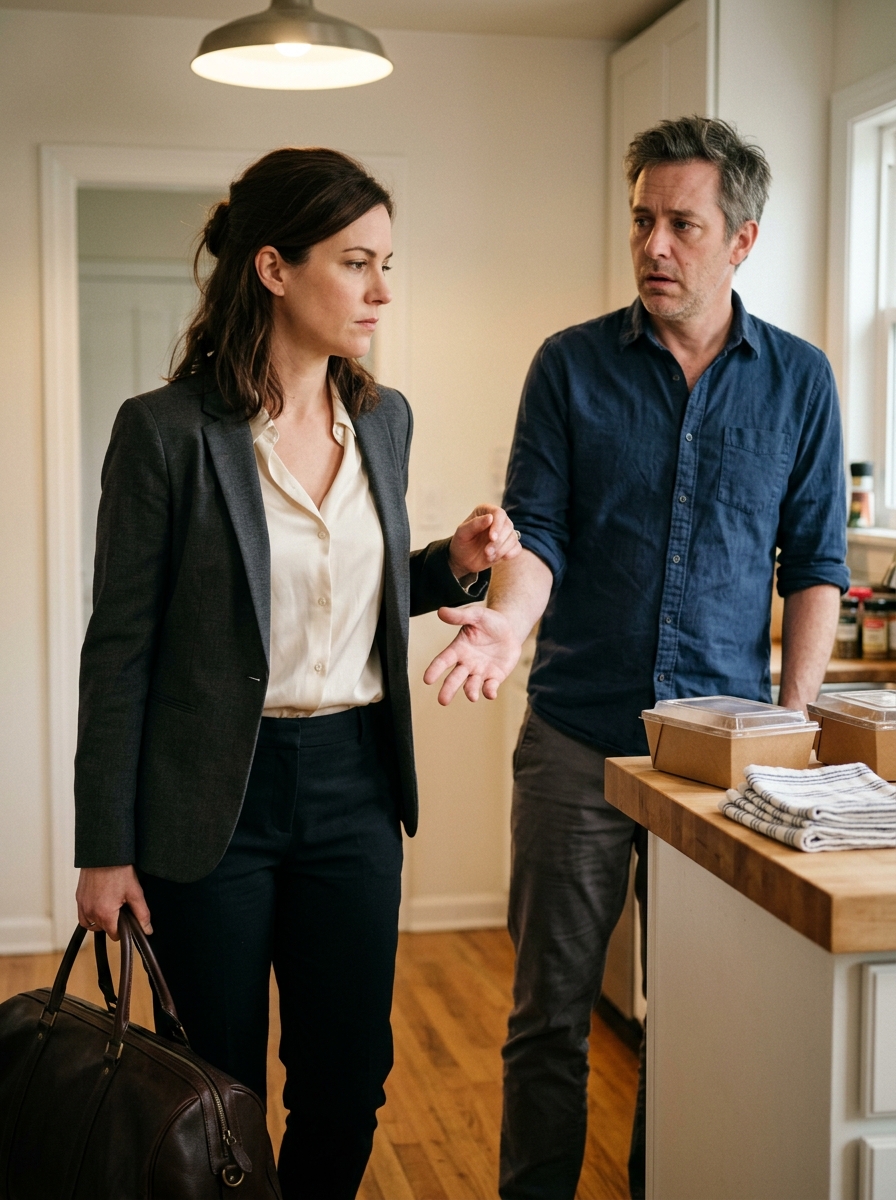
Julian did not ask whether Tessa had already spoken to a divorce lawyer.
He asked whether the appointment on Sunday was with a therapist or a mediator.
“A therapist,” she said from the guest room doorway. “Dr. Anika Solis. Couples work.”
“Couples work,” he repeated.
“That’s what she calls it.”
He stood in the hallway wearing the same gray T-shirt he had slept in, his hair flattened on one side. He looked forty-one in a way he usually didn’t: not old, exactly, but tired of being surprised by the consequences of his own silence.
“Does going mean you’ve decided to stay?” he asked.
“No.”
“Does it mean you’ve decided to leave?”
“No.”
He nodded, as though she had given him a useful answer despite refusing both available options.
Tessa had spent the night in the guest room beneath a quilt her sister had made. The room smelled faintly of cardboard and cedar because it was where they kept their tax records and the extra folding chairs. Julian had offered to move the boxes.
She had said no.
Not because moving the boxes was difficult. Because if he did it, he would make the room suitable for her and call that care. She would thank him, and the conversation would be postponed again.
“I’ll go,” he said.
Tessa studied him. “Because you want to?”
“Because I don’t want our last honest conversation to be the one where you moved upstairs.”
“That’s not an answer.”
“It’s the most honest one I have before coffee.”
She almost smiled. Almost.
Downstairs, they moved around each other in the kitchen with the awkwardness of strangers who knew exactly where the other kept the mugs. Julian reached for the blue one, then stopped.
“Can I make coffee?” he asked.
“You don’t need permission to make coffee.”
“I’m asking whether making it for you would feel like another thing I’m doing instead of talking.”
Tessa leaned against the counter. “I don’t want you to stop doing things. I want you to stop believing things are self-explanatory.”
He waited.
“If you bring me coffee,” she said, “bring me coffee. Don’t expect it to answer whether you miss me.”
He looked down at the machine. “I do miss you.”
“You haven’t said that in a long time.”
“I thought you knew.”
“I knew you would remember to buy oat milk.”
He flinched, and she hated that she saw it. She hated that some part of her felt relieved. Pain was still proof that he could be reached.
They went to work without saying much else.
Tessa owned a custom framing shop three blocks from the courthouse, a narrow storefront with green paint around the windows and a bell that rang too brightly whenever anyone entered. Julian worked for the city’s transportation department, designing route changes and trying to persuade neighborhoods that a bus stop moved six feet for a reason.
They had once teased each other about the difference between their jobs.
“You make decisions people notice,” Tessa used to say.
“You make decisions people hang on their walls,” Julian would reply.
Now their text thread consisted mostly of questions about the house.
Did the plumber ever call?
No.
The mortgage payment cleared.
Okay.
The cat from next door is in our basement again.
Not our cat.
He typed three different messages during the morning.
I’m sorry.
I’m scared.
I love you, but I don’t know how to be married to someone who has stopped reaching for me.
He deleted all three and sent: The recycling pickup is delayed until Thursday.
Tessa stared at the message from the back of her shop, where she was cutting a mat for a watercolor of a storm-battered pier.
She typed, You could have told me you were scared.
Then deleted it.
She replied: I’ll put the bins out Friday.
***
Dr. Solis’s office occupied the second floor of an old brick building that had once been a dentist’s office. The waiting room held two ficus trees, a water dispenser, and a framed print of a blue chair floating in an empty yellow room.
Tessa sat on one end of the couch. Julian sat on the other.
Dr. Solis, a woman in her fifties with silver hair cut close to her jaw, looked at both of them without rushing to fill the silence.
“What brings you here?” she asked.
Tessa gave a short, humorless laugh. “Our marriage is efficient.”
Julian glanced at her. “We function.”
“Those can be the same sentence,” Dr. Solis said.
Tessa crossed her arms. “We don’t fight much.”
“How much is much?”
“Once every few months.”
“What happens instead?”
Julian looked at the floor.
“We manage things,” Tessa said.
“Give me an example.”
“Last week, I had a late appointment at the shop. Julian left dinner in the fridge and texted me to remind me the back door sticks when the temperature drops.”
“That sounds considerate.”
“It was.”
“What’s missing?”
Tessa turned toward him. “He didn’t ask how my day went.”
“I knew how her day went,” Julian said. “She had a client who changed the frame order twice.”
“I told you that three weeks ago.”
“You mentioned it.”
“Exactly.”
Dr. Solis made a note. “And physical affection?”
Tessa felt Julian go still.
“We’re not affectionate,” she said.
“That’s not what I asked.”
“No,” Tessa said. “We aren’t.”
Julian rubbed his thumb against the side of his hand. “We are affectionate in small ways.”
“Name one,” Dr. Solis said.
“I make sure she has coffee before she leaves.”
“That’s service,” Tessa said.
“It’s how I show I care.”
“I know.”
The way she said it made his mouth tighten.
Dr. Solis looked at Tessa. “What does his care feel like to you?”
“Like being maintained.”
Julian stared at her.
She pressed her palms against her knees. “I know that sounds cruel.”
“It sounds specific,” Dr. Solis said.
Tessa breathed in slowly. “He notices everything that needs doing. The loose hinge. The low tire pressure. The insurance deadline. He knows when the water filter needs replacing. But he doesn’t notice when I’m standing beside him wishing he would look at me.”
“I look at you,” Julian said.
“You look at whether I’m tired.”
“Because you’re always tired.”
“And when I’m not?”
He opened his mouth, but no words arrived.
Dr. Solis leaned back. “What does each of you fear would happen if you asked directly for what you wanted?”
Tessa answered first. “That he’d do it because I asked.”
Julian’s eyes flicked toward her.
“I don’t want to be accommodated,” she continued. “I want to be wanted. There’s a difference.”
Julian’s shoulders lowered. “I’m afraid she’d say no.”
“She’s allowed to say no,” Dr. Solis said.
“I know that.”
“Do you?”
He was quiet.
Tessa felt something inside her twist. She had assumed he was afraid of her rejection because he wanted more from her. It had not occurred to her that he might be afraid of what her rejection would say about him.
Dr. Solis looked between them. “You’re both describing a marriage in which no one is making unreasonable demands. That sounds safe. It also sounds lonely.”
Julian gave a small, bitter smile. “We’re very good at safe.”